Racing`s GST Lifeline: A Rule Change?
News: By: Sharan Kumar
November 24 , 2026 |
|
| |
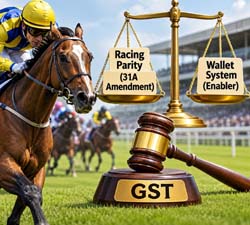
Indian racing is seeking a way out of the mounting GST burden that has weakened the totalisator. A proposal by Ramesh, a racing enthusiast and seasoned global corporate leader, links digital wallets with a demand for GST parity on reinvested winnings. An independent legal opinion says the proposal is viable, but only through an amendment to Rule 31A, opening a possible route to revive regulated betting and challenge the grey market.
Can horse racing secure the GST treatment available to online gaming and casinos for winnings reinvested without withdrawal? Ramesh, a racing enthusiast and seasoned global corporate leader, believes a digital wallet system can help build the case for such parity. An independent legal opinion agrees that the change is possible, but says it requires an amendment to Rule 31A.
The high GST burden on horse-racing betting has been a persistent concern for Indian turf clubs. With totalisator revenues under pressure and funds for modernisation dwindling, the industry needs to explore ways of making betting more attractive and financially sustainable.
Ramesh's proposal goes beyond introducing digital wallets at racecourses. His central objective is to secure for horse racing the same GST treatment that applies to online money gaming and casinos, particularly in respect of winnings retained and used for further play. He sees a digital wallet system as an important enabler of this policy initiative, providing the transaction records and transparency needed to make a credible representation to the Government.
An independent legal examination supports the possibility of such parity, but makes an important qualification: Rule 31A must be amended. The benefit cannot be secured under existing provisions merely by introducing a wallet or adopting a different interpretation of the law.
|
|
| |
The case for GST parity
Ramesh points to the contrast between the expanding gaming industry and the modest revenues of Indian racing. He cites RWITC's totalisator revenue of approximately ?20 crore in FY 2025-26 against an online gaming market estimated at ?23,000 crore in 2024.
He believes racing is losing younger audiences, partly because of outdated betting procedures, long queues and inadequate digital facilities. The financial strain caused by GST has further restricted clubs' ability to modernise.
Under Rule 31A(3) of the CGST Rules, the taxable value of a horse-racing bet is 100 per cent of its face value or the amount paid into the totalisator. At the prevailing GST rate of 40 per cent, the entire stake is subject to tax.
Rules 31B and 31C, governing online money gaming and casinos, contain an Explanation excluding winnings used for further play without withdrawal from the taxable value. Horse racing has no equivalent provision.
Ramesh argues that money already won and retained for another bet should not repeatedly enter the taxable base. Extending similar treatment to racing could reduce the taxable value of totalisator transactions and ease the burden on clubs and punters. The returns on the investment will then be very attractive and can challenge the grey market.
The wallet as an enabler
Ramesh proposes reloadable digital wallet cards at racecourses. Punters could load money, place bets through self-service kiosks and have winnings credited to their accounts.
The system would distinguish fresh deposits from winnings retained for further betting, while recording bets and withdrawals. It could reduce cash handling, shorten queues and make betting more convenient and transparent.
But the larger purpose of the wallet is to create a reliable transaction trail. By clearly identifying fresh money and winnings reinvested without withdrawal, it would provide the accounting framework to support the industry's representation seeking parity under Rule 31A.
The technology and the policy proposal are therefore linked. The wallet would not itself change the GST liability, but could provide the infrastructure needed to implement a revised tax arrangement if the Government accepts the case for amendment.
|
|
| |
The legal position: Amendment is essential
The independent legal opinion is categorical. The Explanation covering winnings used for further play applies specifically to Rules 31B and 31C. Rule 31A contains no corresponding provision for horse-racing totalisators.
The Supreme Court's Gameskraft judgment of May 27, 2026, upheld the validity of Rule 31A and found no statutory basis under the existing framework for excluding prize pools, winnings or payouts while calculating taxable value. This makes a challenge based merely on interpretation or alleged discrimination difficult.
The practical route, according to the lawyer, is a GST Council recommendation followed by a CBIC notification amending Rule 31A to extend similar treatment to horse racing.
A wallet card alone will not change the tax liability. Until the rule is amended, every bet funded through the wallet will continue to be valued at its full amount.
The revised system would also need clear procedures for withdrawals and redeposits, separate records of fresh deposits and retained winnings, and clarity on TDS, KYC and other regulatory requirements.
The industry has also sought GST on the club's commission rather than the entire amount wagered. The legal opinion considers this unavailable under the present framework, particularly after the Gameskraft judgment. A move to commission-based valuation would likewise require a formal change in the rules.
There is, however, a policy argument: a totalisator operates a pooled betting system, retaining a predetermined commission without having a financial interest in the race outcome. Whether this merits a different valuation method is for the Government and GST Council to consider.
A policy approach beyond the courtroom?
If the desired relief requires an amendment, should the industry rely primarily on litigation or pursue a direct policy-level representation?
Zavaray Poonawalla, who has supported Indian racing through generous sponsorships and indicated willingness to fund a legal challenge on the GST issue, could be an influential supporter of the latter approach.
A representation to the Union Finance Minister seeking amendment of Rule 31A to extend to horse-racing totalisators the treatment available to casinos and online money gaming for winnings reinvested without withdrawal could be worth pursuing. The formal route would still require consideration and recommendation by the GST Council, followed by the necessary CBIC notification.
This would not be a demand for exemption from GST, but for parity in the valuation of winnings retained and used for further betting. A coordinated representation by the Turf Authorities of India, supported by influential stakeholders, could give the proposal greater visibility.
If accepted, the change could reduce the tax burden, attract punters back to the totalisator, once the financial backbone of turf clubs, and give clubs room to improve stakes and make racing more competitive. A properly designed digital wallet system could then support the revised framework while improving the racecourse betting experience.
The two perspectives therefore converge on a common objective: secure a more equitable GST framework and modernise the totalisator. The wallet is an enabler of the proposed reform; the essential step is a change to Rule 31A.
Is this a proposal worth pursuing collectively? The question now rests with the racing fraternity and, above all, the turf authorities.
|
|
|
|
|