| |
Photofinishes are among racing`s great little dramas. A race that lasts a couple of minutes can sometimes require a photograph to decide a difference of mere millimetres. But occasionally the photograph itself creates a mystery.
This finish from the 2021 Diomed Stakes at Epsom is one such example.
Oh This Is Us, ridden by Tom Marquand, got up in the final strides to defeat Century Dream in a desperate finish. The official verdict was a nose. The contemporary reports were unequivocal about the result.
But look closely at the photograph.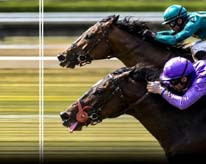
The winner`s tongue is protruding dramatically, apparently beyond the nose of the horse alongside it. The picture almost gives the impression that the horse has won the race with its tongue rather than its nose. Even the horse`s trainer Richard Hannon joked afterwards: “he won by a nose (although looking at the photo finish...was it a tongue?!)”
There is, however, an important technical point. The British Horseracing Authority says that when determining a close finish, the judge places the photo-finish line on the leading part of the horse`s head, excluding the ears and the tongue, normally at the point of the nose.
That makes the photograph even more intriguing.
Was this genuinely a nose verdict, with the nose of Oh This Is Us fractionally ahead of Century Dream`s nose, while the protruding tongue merely created the optical illusion of an even closer finish?
Or, looking at the photograph, was the position of the two noses so close that it could reasonably have been a dead heat if the exact reference points could not be established?
The published result says a nose, not a dead heat. The official record also gives the winner 1st and Century Dream 2nd, beaten by a nose.
But photographs such as this are precisely why photo-finish judging is an art as well as a science. The camera records the evidence; the judge interprets it according to the rules.
So here is a question for the learned Indian stipes:
Looking at this photograph, can you throw light on how the verdict should be interpreted? Was the winning margin determined strictly by comparing the noses, as the rules prescribe, or is there anything in this photograph that could suggest a dead heat? And, most intriguingly, could the protruding tongue have created an apparent advantage which has led many observers to believe that it was the tongue that won the race?
Officially, it was a nose. But this photograph leaves the tongue with a very persuasive claim to the credit.
Postscript: When the Photofinish Gets a Second Look
Photofinish decisions are not infallible, even in England, where sophisticated equipment and additional checks are used.
At Sandown in 2019, the wrong horse was initially declared the winner because the judge had been given a photograph from the wrong winning post. The mistake was detected before the weighed-in signal, and the result was reversed.
At Kempton in 2018, Bird For Life was initially declared the winner, but a subsequent review of the photograph resulted in Oregon Gift being promoted to first. The BHA subsequently introduced an additional verification process before the weighed-in announcement.
Perhaps even more fascinating was Sandown in 2021, when Phoenix Star was initially called the winner over Hurricane Ivor. A second image appeared to suggest the opposite, but the stewards eventually ruled that the mirror image was distorted and could not be relied upon, resulting in a dead heat.
These incidents raise an interesting question for Indian racing: When an exceptionally close finish is announced, what exactly is the procedure before the white cone is hoisted and the result becomes final? Can the judge revisit the primary image, the mirror image and other available evidence, and under what circumstances can an announced verdict be recalled?
That would be a worthwhile subject for the learned Indian stipes to explain, particularly in a finish as extraordinary as the one under discussion.
|
|




 Top
Top
